• Skip to main content

Cut Lunch Adventures

TREK | LEARN | ENJOY

  • Adventure Resources
    • 1. Adventure Ideas
    • 2. Trek Preparation
    • 3. On Adventure
    • 4. Post-Adventure
    • Tools & Calculators
    • Insurance for Trekking and Mountaineering
      • Insurance for Trekking and Mountaineering
      • Insurance for Australians
      • Covid Insurance
    • Shop
    • Useful Links
  • Where To Go
    • Trek Finder Wizard
    • Himalayas
    • New Zealand
    • Australia
    • North America
    • South America
    • Europe
    • Asia
    • Middle East
  • Self Discovery
  • Fun
  • About
    • Our Story
    • How We Can Help You
    • Testimonials
    • Why Cut Lunch?
  • Contact
    • Contact Us

Trekking

Trekking and Mountaineering Insurance for Australians

Published February 2022 by Emma. Updated February 2026.

We wrote this article to cover trekking and mountaineering insurance for Australians, as it’s often hard to find. As we often search for our own needs, we decided to share our findings to help others. You can also check out our other article with general info and tips on Trekking and Mountaineering Insurance.

Our focus is on insurance for high altitude and also for the use of mountaineering equipment when needed (helmet, crampons, ice axe, ropes, harness etc).

We’ve reviewed over 45 providers, encompassing insurance companies, rescue specialists, alpine clubs, climbing clubs, recommendations from expedition companies, aggregator & comparison websites, blogposts, as well as talking to other trekkers and mountaineers. As of 2026 we’re no longer reviewing each provider, but this blogpost will hopefully at least give you some pointers of what to look out for.

Disclaimer: This is general information based on our research. As always, you should read the latest policy fine print, online reviews and consider your own personal requirements. We are not using affiliate links in the content of this article and do not earn commission from any insurance companies that we mention.

In this post:
  • The Australian Travel Insurance Market
  • What to Consider when Searching for Trekking and Mountaineering Insurance
  • Trekking and Mountaineering Insurance for Australians as at 2025
  • Tips for Making a Travel Insurance Claim
  • Useful links

The Australian Travel Insurance Market

Things are changing all the time so its always worth searching for new offerings or tighter restrictions.

Improvements we’ve found in recent years are:

  • new providers with more modern websites and easier to understand language
  • innovative offerings e.g. as at 2025 we found
    • instant cash payouts (PassportCard and Flip (via HCF, but for accident injury only)
    • Freely (via Cover-More/Zurich) is a ‘travel insurance and safety app’
    • Battleface which includes Space Travel Insurance!
    • Overwatch Rescue launched a direct-to-consumer service in February 2025
  • World Nomads international brand has been sold by NIB to IMG (announced February 2026)

Restrictions we’ve uncovered often relate to specific countries or regions e.g.

  • a few providers specifically exclude Nepal – not helpful for trekkers going there
  • we read that if you’re in the UK/EU and are going trekking in Nepal, that most insurers have a policy excess of £750/€900 if you need to be rescued by helicopter for medical reasons. So check the policy fineprint in case this becomes the trend in Australia.

Some policies just don’t make sense eg last time we checked, NIB policies allow up to 6000m but don’t cover activities on snow and ice!!! (except for their skiing package and their World Nomads branded policy). Not much help for mountaineering.

What to Consider when Searching for Trekking and Mountaineering Insurance

Read the section in our main article on Trekking and Mountaineering Insurance – What to Consider which covers:

  1. Decide what type of cover you need
  2. Create a shortlist of providers based on your minimum requirements
  3. Check other important factors
  4. Weigh up cost vs risk
  5. Read the fine print of the policy before you purchase it.

Trekking and Mountaineering Insurance for Australians as at 2025

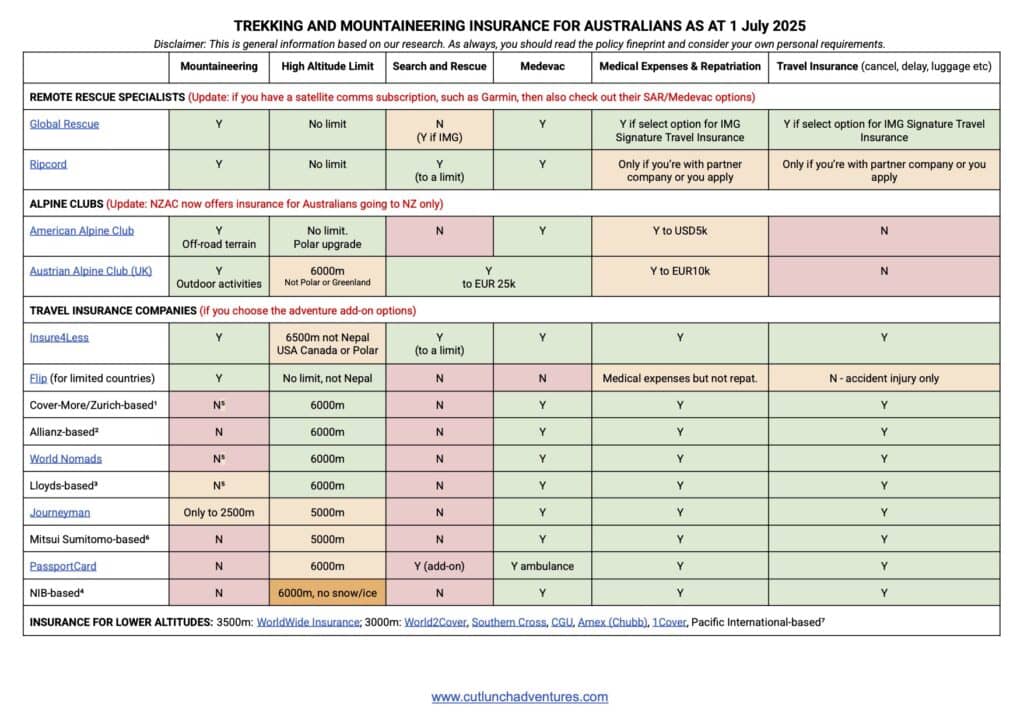
As at 2026 we’re no longer reviewing individual providers, but feel free to use our last review as at 2025 to kickstart your own research. See the image below or download it as a free pdf (no email required!). You may need a combination of providers to get all the cover you need. Links in the image are listed below.

For detailed descriptions of the types of providers, please refer to the section in our main article on Trekking and Mountaineering Insurance that cover:

  1. Check with your expedition company first
  2. Remote Rescue Specialists
  3. Alpine Clubs
  4. Travel Insurers
  5. Reciprocal Health Care Agreements and NZ ACC
  6. Insurance Aggregators/Comparison Websites
  7. Online Reviews
  8. Nepal Helicopter Rescue Scams
Summary table of trekking and mountaineering insurance for Australians
Download the PDF

NOTES

Rock & Ice climbing: some of the providers we reviewed allow for rock climbing, bouldering and ice climbing even if they don’t allow for the broader definition of mountaineering (with ropes, crampons, ice axe etc). Some have limits on altitude with rock climbing or certain types of rock climbing. We have not done a complete review of rock or ice climbing as our focus is high altitude trekking and mountaineering.

Seniors discounts worth checking out e.g. NSW Seniors discounts https://www.nsw.gov.au/community-services/seniors-card/deals-discounts/insure-and-go

Some policies require your mobile phone IMEI in the event of a claim, so make a note of it before you travel e.g. “We will not pay any claim relating to a mobile phone or device with phone capabilities if you are unable to supply the IMEI (International Mobile Equipment Identity).”

Smarttraveller travel advisory: check what you’re covered for if the advice-level changes before or during your travel e.g. last time we checked, WorldNomads specifically call this out. Others don’t and you may need to ask them e.g. in 2025 when Nepal advice changed from ‘exercise a high degree of caution’ to ‘reconsider your need to travel’ we asked our insurer who said that we’d be covered if we bought the policy before advice changed (and we had a valid reason to cancel the trip before it started), but if we chose to go then we were uncertain/unlikely to be covered. So we had to buy a new policy that covered that advice level.

LINKS INCLUDED IN THE ABOVE IMAGE

Remote Rescue Specialists

(see main article for description here)

  • Global Rescue
  • Ripcord
  • if you have a subscription for your satellite communications device, check out any add-on options for search, rescue and medevac e.g..
    • GEOS IERCC via Garmin inReach, Iridium or Inmarsat
    • FocusPoint via GlobalStar/SPOT
  • Overwatch Rescue

Alpine Clubs

(see main article for description here)

  • American Alpine Club
  • Austrian Alpine Club (UK)
  • New Zealand Alpine Club

Travel Insurers – Higher Altitudes

Note: A lot of brands have the same underlying Insurers. However note that each brand is priced differently based on the specific cover they provide – so read the fine print. We’ve also noticed that the process and service levels are not so good for policies sold by resellers or agents (rather than going direct to the main Insurer) – both for arranging evacuation and also when making claims.

  • Insure4Less
  • Flip
  • Cover-More based policies (underwritten by Zurich) are sold by Cover-More, Medibank, AHM, Webjet, NRMA (update Oct 2025: no altitude limit with NRMA?), Freely. Virgin Australia is slightly different in that they link you to Cover-More as their partner.
  • Allianz-based policies are sold by: Allianz, WorldCare, Boomers
  • World Nomads (update Feb 2026: World Nomads international brand has been sold to IMG – so not sure how this policy will change or
  • Lloyds-based policies: FastCover, Zoom
    • Zoom allows outdoor rock climbing
  • Journeyman (via Campbell Irvine)
  • Mitsui Sumitomo-based policies: Insure&Go, Tick
  • PassportCard
  • NIB-based policies (underwritten by XL Insurance Company SE) are sold by: NIB, Qantas, Travel Insurance Saver, Travel Insurance Direct and Cota
    • note that World Nomads is also an NIB-based insurer but we’ve listed this separately because unlike the other NIB-based policies they don’t exclude activities on snow/ice and they DO offer insurance for high altitude trekking (but not mountaineering). They also are the only one we’ve seen so far that specifically call out that you’re covered if the travel advisory changes after you bought the policy and booked arrangements… not to say that others exclude it though.
      • UPDATE FEB 2026: World Nomads sold to IMG – will be interesting to see how their policy changes for Australians, or whether NIB update their Australian-based policies to allow for more adventure activities including snow/ice.
    • also note that for Cota, while they say they provide insurance for senior Australians, there is no age limit for their Comprehensive or Annual plans
    • if you’re looking at any of the NIB policies (except for World Nomads) and need cover for snow/ice then check with them and get their response in writing. We experienced conflicting views from Travel Insurance Saver: one trekker was told that they would be covered for trekking on snow/ice yet when we submitted a query we were told that trekking on snow/ice would not be covered

Travel Insurers – Lower Altitudes

  • 3500m: WorldWide Insurance
  • 3000m: World2Cover, Southern Cross, CGU, Amex (Chubb), 1Cover, Pacific International-based policies (Battleface, Trippi, Travel Protect)

These are just some examples – there are many other travel insurance providers who also insure for lower altitudes.

OTHER IDEAS

Credit Card Travel Insurance

Travel insurance that comes with your credit card can sometimes cover you, at least for your basic travel needs, but they are usually more restrictive than the purchased policies e.g.

  • Excluding travel advisories of ‘reconsider your need to travel’ as well as ‘do not travel’
  • Excluding higher altitudes unless you purchase the adventure add-on
  • The amount of cover you get is often not as much as policies that you buy
  • Check what you need to do to activate the policy eg register the trip to get a policy, spend a certain amount on your trip using the credit card and have the bank statement to prove it
  • Check whether the policy is still valid if your credit card has to be replaced

Check for Discounts

It’s worth checking with your health insurer or any other memberships you have in case they provide discounts on travel insurance.

Annual Policies

If you’re doing a lot of travel then an annual policy is often cheaper than buying multiple policies.

Tips for Making a Travel Insurance Claim

Read the section in our main article for Tips on making a Travel Insurance Claim which covers:

  1. Know and follow the rules of the policy (although some can be unreasonable e.g. requiring a PCR test in a remote area)
  2. Make every effort to reduce extra costs and document how you did this in your claim
  3. Get all the supporting documentation if something goes wrong
  4. Make your claim easy to read and in the correct format

Useful links

Some other good posts on the Australian market for trekking/mountaineering insurance:

  • https://52adventuresblog.com/tag/travel-insurance-for-australian-climbers/
  • https://www.facebook.com/andrew.lock.8000metres/posts/2003963389836748
  • https://www.canstar.com.au/travel-insurance/cover-for-mountain-trekking-hiking/
  • https://www.finder.com.au/travel-insurance-trekking
  • https://www.comparetravelinsurance.com.au/travel-insurance-tips/climbing-trekking-travel-insurance

General guides on Australian travel insurance:

  • https://www.smartraveller.gov.au/choice-travel-insurance-buying-guide
  • https://www.choice.com.au/travel/money/travel-insurance/buying-guides/insurance

For travel to NZ:

  • https://www.choice.com.au/travel/money/travel-insurance/articles/travel-insurance-new-zealand
  • https://www.smartraveller.gov.au/destinations/pacific/new-zealand
Helicopter Rescue - Trekking and Mountaineering Insurance for Australians

Trekking and Mountaineering Insurance

Published February 2022 by Emma. Updated February 2026.

The most un-fun part of an expedition – trying to find the right travel insurance policy to cover trekking and/or mountaineering. Here’s a summary of what to look for and what we found.

If you’re from the UK, Europe or USA there are plenty of options. For Australians, if you so much as think about using a rope then the options dry up fast.

Our focus is on insurance for high altitude and also for the use of mountaineering equipment when needed (helmet, crampons, ice axe, ropes, harness etc).

This article includes general information about travel insurance for all trekkers and mountaineers regardless of where you live. We have a separate article which details options for Aussies. We reviewed over 45 providers encompassing insurance companies, rescue specialists, alpine clubs, climbing clubs, recommendations from expedition companies, aggregator & comparison websites, blogposts, as well as talking to other trekkers and mountaineers. As of 2026 we’re no longer reviewing each provider, but this blogpost will hopefully at least give you some pointers of what to look out for.

Disclaimer: This is general information based on our research. As always, you should read the latest policy fine print and online reviews, and consider your own personal requirements. We are not using affiliate links in the content of this article and therefore do not earn commission from any insurance companies that we mention.

In this post:
  • What to Consider when Searching for Trekking and Mountaineering Insurance
  • Trekking and Mountaineering Insurance
    • Remote Rescue Specialists
    • Alpine Clubs
    • Travel Insurers
    • Reciprocal Health Care Agreements and NZ ACC
    • Insurance Aggregators/Comparison Websites
    • Online Reviews
    • Nepal Helicopter Rescue Scams
  • Tips for Making a Travel Insurance Claim

There are new travel and adventure insurance providers popping up all the time. so it’s always worth a quick search to see what’s new. Many are just different brands who use the same underwriters. In these cases the policies are largely the same, with perhaps a few tweaks depending on the pricing or the type of travel that they specialise in.

What to Consider when Searching for Trekking and Mountaineering Insurance

  1. Decide what type of cover you need e.g. evacuation (usually from a known location), medical expenses, general travel insurance (cancellation, trip curtailment, delays, lost luggage etc), Covid, search and rescue (from an unknown location – not offered by all insurers) etc
  2. Create a shortlist of providers based on your minimum requirements e.g. highest altitude, type of activity (trekking, use of mountaineering equipment etc), destination country and travel advisory level (and if it changes – WorldNomads is the only policy we’ve found so far that specifically calls out cover for this … not to say that others exclude it though – you’ll just need to ask them). Length of trip is also important – some policies have a limit of 30 days per trip.
  3. Check other important factors e.g. pre-existing medical conditions, your eligibility (age, country of residence), risk of weather delaying internal flights, risk of natural disasters e.g. avalanches causing injury or landslides causing delays on your drive to/from trailhead, can you get a refund if your trip doesn’t proceed and you don’t need the policy any more? Note: If you’re working in a professional capacity, such as guiding, then you may not be eligible for some policies.
  4. Weigh up cost vs risk
    • Cost of the insurance policy and excess
    • Risk
      • what could happen (“events”) and how likely e.g. injury, illness, bad weather, natural disasters etc
      • what you could lose (“cover” you need) e.g.
        • cost of expedition, flights, gear
        • extra costs you could incur e.g. search, rescue, medical & repatriation, extra accommodation, flight changes
  5. Read the fine print of the policy before you purchase it. If needed, contact the insurer to get clarification (in writing) of what you’ll be covered for. Especially check for
    • General exclusions
    • Definitions of words with special meaning

Trekking and Mountaineering Insurance

There are 3 main sources of insurance for trekking and mountaineering which we’ll cover in this section – remote rescue specialists, alpine clubs and travel insurers. You may need to use a combination to get all the cover you need. We’ve also added some other aspects which are worth being aware of too.

Check with your expedition company first

If you’re going with a trekking or mountaineering expedition company then check their website or ask their advice. They often have requirements and recommendations for insurance. In some cases they may provide a referral – most often to companies like Global Rescue or Ripcord (via Redpoint) for rescue, and IMG Travel Insurance or Cover-More for travel insurance.

Remote Rescue Specialists

These companies specialise in rescue/evacuation, which is a membership service rather than insurance. You can join as a short-term or longer term member. Depending on your circumstances you may be eligible to purchase their optional add-ons of medical expenses and travel insurance. Examples:

  • Global Rescue
  • Ripcord (through Redpoint)
  • if you have a subscription for your satellite communications device, check out any add-on options for search, rescue and medevac e.g.
    • GEOS IERCC via Garmin inReach, Iridium or Inmarsat
    • FocusPoint via GlobalStar/SPOT
  • Overwatch Rescue launched a direct-to-consumer service in February 2025

What to Check or Be Aware Of

  • Rescue/evacuation service
    • Usually no limit on altitude, and allows for mountaineering
    • Polar regions are usually not covered unless you buy an upgrade
    • Some include Search whereas others will only rescue you from a known location
    • Usually require you to have 2-way sat comms e.g. Garmin inReach .. but check the rules of your destination country in case there are restrictions on these devices.
  • Insurance add-ons – while these memberships don’t include travel insurance, some offer Insurance add-ons to cover medical expenses, cancellation, luggage etc. However you aren’t necessarily eligible.
  • Hospitalisation – check what qualifies as a ‘rescue’ e.g. when we last checked, Global Rescue FAQ says that they’ll rescue you even if you don’t need hospitalisation. However their policy specifically says that they’ll evacuate for injury/illness which is life-threatening and/or requires hospitalisation. Ripcord have the hospitalisation clause too.
  • Travel advisory level (for your destination country) – it’s not very clear as to which advisory levels they include or exclude

Alpine Clubs

Some of the Alpine Clubs around the world offer a limited amount of rescue and medical expenses (not general travel insurance) for their members while participating in mountain-related activities. Other clubs are focussed more on providing access to ski lodges and mountain huts. This is what we found as at 2025:

Of those offering rescue/medical, some only allow membership from within their region e.g.

  • British Mountaineering Council
  • German Alpine Club
  • French Alpine Club

Others are open to international membership e.g.

  • Austrian Alpine Club (in German) which includes sections for
    • Belgium
    • Poland
    • Slovakia
  • Austrian Alpine Club (UK Branch) – in English
    • Search and Rescue from off-road terrain including medical and repatriation
    • Up to 6000m (with the extension >6000m only available to EU residents)
    • Excludes Polar regions and Greenland
  • American Alpine Club
    • Rescue (not search), medical and repatriation – depending on membership level. Designed for any outdoor activity.
    • No altitude limit (as far as we can see)
    • Excludes Polar regions unless you purchase the Polar Upgrade
    • They have a variety of membership options with different levels of cover.
    • Note that for more comprehensive coverage, they recommend that you buy a full membership with Ripcord, which you can get with a discount if you also buy their travel insurance. (They used to partner with Global Rescue but have switched)
  • New Zealand Alpine Club – offer insurance as follows:
    • New Zealanders travelling anywhere. Polar regions are assessed on a case by case basis. Various activities covered including trekking to 6000m and mountaineering to 7000m depending on the level of cover you choose.
    • Australians travelling to New Zealand

Travel Insurers

These companies provide general travel insurance but are usually limited in the adventure activities and altitudes they cover. You often need to buy the higher level plans or adventure optional add-ons to get the cover you need. They are:

  • Likely to include evacuation, medical expenses, cancellation, delays, lost luggage etc
  • Unlikely to include cover for mountaineering activities
  • Unlikely to include Search and Rescue 

It’s sometimes worth checking with your airline or health insurance fund in case they offer travel insurance through them for a better price.

We’ve done a detailed review of options for Trekking and Mountaineering Insurance for Australians here.

For residents of other countries you’ve probably got many more options which you’ll need to research yourself. Here are some we are aware of:

UK: TrueTraveller, Campbell Irvine, SnowCard, Dogtag, Adventures, SportsCoverDirect

USA: TripAssure, Travel Guard, Squaremouth (aggregator)

Canada: TuGo

International:

  • WorldNomads (although may not be selling in all regions yet due to Covid)
  • IMG Global (no options for Australians unless you go via Global Rescue)
  • WorldTrips (formerly HCC Atlas – excludes Australians and Canadians)
  • Global Underwriters for travel to USA (excludes Australians)
  • Journeyman (via Campbell Irvine) for international residents
  • WorldWideInsurance (for UK residents and some options for international)
  • ColumbusDirect (not selling to Australian region)
  • Clements (no options for Australians)
  • BattleFace
  • (IHI/Bupa are no longer selling travel insurance)

For more information here’s another good article about Travel, Rescue and Medical Evacuation Insurance.

Reciprocal Health Care Agreements and NZ ACC

Depending on the country you’re travelling to, you may have access to these health care services. However you’d still need travel insurance to cover all other situations. Examples as at 2025:

Reciprocal Health Care e.g.

  • New Zealand has reciprocal health care agreements with Australia and U.K. For Australians visiting NZ, ensure you take your Medicare card with you.
  • Australia has agreements with 11 different countries
  • United Kingdom also has a list of agreements

NZ Accident Compensation

  • If you’re travelling to New Zealand, there is also the unique ACC no fault scheme which provides health care if you have an accident. You may or may not have to pay part of your treatment costs.

Insurance Aggregators/Comparison Websites

They can be useful as a general overview or they can just be plain annoying if they don’t give you a full set of options because they’re biased by the commissions they’re paid.

Some have useful blogposts such as these (Aussie-based, but still some useful info for everyone)

  • https://www.comparetravelinsurance.com.au/travel-insurance-tips/climbing-trekking-travel-insurance
  • https://www.finder.com.au/travel-insurance-trekking

Online Reviews

All insurance companies seem to have good/bad reviews, and a lot come down to

  • How many questions you need to ask them before deciding to buy the policy and their quality/timeliness of response (we’ve not had issues here, but haven’t needed to ask much)
  • Claiming – depends on how diligent you are in your claim. Again we’ve had good experiences with a few companies which others have complained about.

Post Covid, many insurance companies have staff shortages or other issues which have impacted their customer service (e.g. response time for claims or queries).

Nepal Helicopter Rescue Scams

If trekking or mountaineering in Nepal, be aware of some of the tricky tactics that have been used in the past. Hopefully some of the operators have cleaned up their act since then. In 2018 the trekking world was abuzz with various scams which you can read about here:

  • https://www.nepalitimes.com/banner/heli-rescue-fraud-tarnishes-nepals-image/
  • https://www.airmedandrescue.com/latest/news/focus-helicopter-evacuations-nepal

Always check the policy fineprint wherever you’re based as things often change e.g. we read that if you’re in the UK/EU and are going trekking in Nepal, that most insurers have a policy excess of £750/€900 if you need to be rescued by helicopter for medical reasons.

Tips for Making a Travel Insurance Claim

  1. Know and follow the rules of the policy (although some can be unreasonable e.g. requiring a Covid PCR test in a remote area) e.g.
    • by knowing the correct insurance emergency number to contact for medevac. Your expedition company usually asks for your policy details so that they can assist with this
    • They may require that you have 2-way comms, such as a sat phone … but check the rules of your destination country in case there are restrictions on these devices.
  2. Make every effort to reduce extra costs and document how you did this in your claim e.g.
    • upfront
      • buy flexible flights
      • getting vaccinations
    • if an event occurs
      • try to move flights and accommodation without penalty
      • or get a refund from airline or expedition company
  3. Get all the supporting documentation if something goes wrong
    • e.g. letter from hospital, expedition company, airline etc
    • note: insurers seem to want increasingly more and more information – so ensure you get all the evidence you can to support your claim
  4. Make your claim easy to read and in the correct format e.g.
    • Submit the claim in the required format e.g. an online or pdf form as specified on the insurer’s website
    • Provide all information they ask for, in a logical order
    • Refer to the specific section/wording in the policy that you’re claiming for
    • Attach all necessary documents
    • Beware – if they have to request more information from you, or the necessary forms etc, then the clock may restart for the claim response time (the promised turnaround time of 10 days, 30 days etc to assess and respond to your claim)
Helicopter Rescue - Trekking and Mountaineering Insurance

Australia: Jagungal Wilderness, Kosciuszko National Park

Published June 2021 by Trevor. Updated February 2025.

In this post:
  • Introduction
  • First Day: Round Mountain Trail Head to Derschkos Hut – 14km
  • Second Day: Derschkos Hut to camp site, via Mt Jagungal – 12km
  • Third Day: Camp site to Grey Mare Hut – 10km
  • Fourth Day: Grey Mare Hut, via Valentines Hut to Schlink Hut – 14.5km
  • Fifth Day: Schlink Hut to White River Hut – 5km
  • Sixth Day: Change of plan! Detour from White River Hut to Ski Lodge in Perisher – 12km
  • Final Day in the Jagungal Wilderness. Charlotte Pass to Thredbo – 22km
  • Insights – Jagungal Wilderness

Introduction

If you haven’t been hiking in the Jagungal Wilderness, located in the northern part of Kosciuszko National Park, then do it!

Commencing at the Round Mountain trailhead, six hardy souls trudged out for the start of a big adventure. The plan – hike the Great Alpine Trail some 100kms back to Thredbo, camping and carrying all our food and gear for 7 days. With a hardcopy of the relevant topo maps, downloaded map of the area plus a compass and a Garmin InReach added for additional safety.

From our research, we had a good idea of the route and huts we could utilise in case of emergency. We did decide to take the opportunity to camp by the huts where available and utilise them for preparing our meals.

Mt Jagungal in he Jagungal Wilderness
Mt Jagungal

First Day: Round Mountain Trail Head to Derschkos Hut – 14km

Departing Thredbo early in the morning, we set off for the 2 hour drive to the Round Mountain trail head (via Khancoban). Carrying full packs in very wet conditions and despite the rain, the day ended up being an easy one. What a great introduction to the Jagungal Wilderness.

As luck would have it, after consuming our soggy lunch, the sky cleared to reveal a nice sunny day ahead. Reaching the camp site before sunset, we managed to get a fire going in the fire pit outside. We settled in for the night, sharing a good yarn or two – minus the one million blood sucking March flies!

Campsite at Derschkos Hut

Second Day: Derschkos Hut to camp site, via Mt Jagungal – 12km

This turned out to be a tough day. Navigation skills came to the fore, that and swatting away some one million March flies – well, it certainly felt like there was one million! They managed to bite through every piece of clothing and human flesh possible. No amount of swatting, kicking or screaming kept them at bay. Staring into their big beady eyes didn’t scare them away either!

Bushbashing in the Jagungal Wilderness
Bushbashing

Picking our way through head high undergrowth bush bashing Aussie style, we finally navigated our way up to a high ridge after about 3 hours. Reaching the ridge, we picked up a faint trail. Dropping our packs at the base, we had a short rock scramble which led us to the top of Mt Jagungal (2,061m) – the seventh highest mountain in Australia. With the sun shining, a slight breeze and 360 degree views of the surrounding Jagungal Wilderness area, this is as good as it gets on any summit day.

Summit of Mt Jagungal

Descending, we hit a few bogs – and more biting March flies. Apparently, the March fly uses the protein in the blood to develop eggs, which give rise to the next generation of March flies. Hmmm!

Back to the trail. We could roughly make out where we were headed, up to the Stromlo Range. So with map and compass in hand we continued to zig zag across the swampy area and up the hill until we were all exhausted. Finally reaching a spot where we could pitch a tent and that also had running water nearby, we called it a day.

Yellow Wildflowers
Wildflowers en route

Dining alfresco, with the stars shining ever so brightly in the sky above us, we fell asleep content with how the day unfolded. Looking up at the clear night sky and sighting the Southern Cross along with other constellations was a sight to behold.

Lunchbreak near the Stromo Range
Lunchbreak near the Stromlo Range

Third Day: Camp site to Grey Mare Hut – 10km

Today, was up and over another ridge that intersected with the Grey Mare trail. Finally ending up at our our destination of Grey Mare hut. Along the way through the swampy area, we came across numerous yabby holes – the small Australian equivalent of a freshwater crayfish species.

After setting up camp, we headed to the nearest water source, an easy 50m from our campsite. Judging by some old implements lying around, it appeared this was once an gold mining site from the 1800s.

During bad weather, Grey Mare is considered to be one of the key survival shelters in the Jagungal Wilderness.

Grey Mare Hut
Grey Mare Hut
Goldmining equipment near Grey Mare Hut

Fourth Day: Grey Mare Hut, via Valentines Hut to Schlink Hut – 14.5km

This was what I call Type 2 fun day. Involving three river crossings around knee to waist high, it was gear off and gear on. Rinse, dry and repeat! Reaching Valentines Hut was one of the highlights of the hike – it’s door is painted bright red, so aptly named. It’s also a great spot to have a lunch break and take in the surroundings.

River Crossing in the Jagungal Wilderness
River Crossing
Valentines Hut
Valentines Hut

After lunch, things got a bit interesting at a T junction on the trail. Reaching Schlink Hut, also known as ‘Schlink Hilton’, we realised that one of our party hadn’t arrived. On dusk, we dispatched a small search party and managed to find him within the hour and in good spirits. However, it appeared that the darn March flies had also sent out a search party and found us too!

Schlink Hut
Schlink Hut

Fifth Day: Schlink Hut to White River Hut – 5km

This turned out to be a very short day. Plan A was to go from Schlink Hut up and over a ridge and camp near Mt Tate, following the Great Alpine trail.

As the Alpine weather forecast was not looking great, we contemplated alternatives. Reaching White River Hut after a short hike, we pitched our tents. This was just in case it became very busy with overnight hikers coming up from Guthega Power Station. A decision that proved wise as it turned out.

Some of the hardy group decided to press on and see if they could tag Mt Tate and return to camp. It was tough going, with the trail disappearing into head high undergrowth and remerge many metres away – again and again. So, after a few hours the two of us decided to turn around and head back down. The thought of a delicious lunch of salami and cheese coupled with dessert was also an attractive option to return to.

Today was the first after 5 days that we encountered other people. They were with a local alpine club who had hiked up from the power station. It was nice to have a conversation with someone other than our own.

White River Hut, Jagungal Wilderness
White River Hut

Sixth Day: Change of plan! Detour from White River Hut to Ski Lodge in Perisher – 12km

What’s that saying? The best laid plans of mice and men get led asunder! The updated weather report didn’t look promising, limiting our options to head up and follow the Great Alpine Way further across the top.

With an alternate trail closed because of a collapsed bridge, another detour was the order of the day. When one of our fellow companions suggested we could bunk down at their ski lodge for the night with a hot shower and comfy bed – well, need we say more. It wasn’t a hard decision. However, now we had to find our way.

The first section of our new detour was a service road which lead down to the Guthega Power Station and car park, around 8km. The power station formed the original part of the great Snowy Mountains Hydro scheme. It was on this road that we encountered some more people – a large bush walking group. They were also headed up to White River Hut – a very popular destination, so it seems, for an overnight hike.

Guthega Power Station

Upon reaching the power station, it was ‘now where’? With a little assistance from MapsMe and some local knowledge, we began our long zig zag ascent to Perisher. To our detriment, we had to hike up an incredibly steep ski slope – the ‘Blue Cow Black Run’.

Now, I’ve never attempted a black ski run in summer – come to think of it, in winter either! So here we were, up and up we went – straight up in fact. The thought of a hot shower at the end seemed to spur us on. Finally, we trudged into the very quite but quaint village of Perisher and onto the ski lodge.

The highlight of our stay was being able to access a well stocked pantry. Making scones for afternoon tea and having a well earned pasta dish for dinner, there was definitely no hydrated food for us tonight.

Fresh scones
Fresh scones (yum)

Final Day in the Jagungal Wilderness. Charlotte Pass to Thredbo – 22km

After a well earned rest, we poked our heads outside to see that the weather forecast was spot on. 100mm of rain plus 40-60km winds were headed our way – some of it having reached us already. After some consultation, we arranged for a shuttle bus to come and pick us up and take us on the short drive to Charlotte Pass, around 12km, so that we could resume our hike back down to Thredbo.

View from Charlottes Pass

Some of our merry troupe decided to walk the 22km loop of the main range – crossing the Snowy river and up around tagging Mt Kosciuszko and then down to Thredbo village accessing the chair lift at Eagles Nest.

Given the dire weather forecast and because we’d previously hiked that trail, we elected to cut it short and head the most direct route down to Thredbo, a distance of some 16km. Taking shelter in Seaman’s hut along the way, looking like drowned rats, we waited out some of the bad weather. After an hour or two, we finally made a decision to hot foot it down in what was a record time for us at least.

Seamans Hut
Seaman’s Hut

Finally, we reached the village of Thredbo, where our journey began 7 days ago. Curling up in our warm cosy lodge to dry out, we reminisced with the others when they arrived over a well earned dinner washed down with a glass or two of red wine!

Onwards and upwards!

Trevor

Chairlift down to Thredbo

Insights – Jagungal Wilderness

  • Register your trip intention form online with NSWPS or in person at the Snowy Region Visitor Centre, Jindabyne or Khancoban Visitor Centre.
  • Kosciuszko National Park entry fee applies, regardless of the season.
  • Given a wet summer, there was ample water supply along the way.
  • All of the huts we encountered in the Jagungal Wilderness were in excellent condition. They would make great emergency shelters if you encountered extreme weather.
  • Be prepared – pack appropriate gear, water, tent, compass, PLB and maps of the area.
  • March flies are not active early in the morning or at dusk – luckily they do sleep!!
  • Read our other posts about adventures in the Kosciuszko National Park here.
View over the Jagungal Wilderness
View from Mt Jagungal

Australia’s Ten Highest Peaks

Published December 2020 by Trevor. Updated September 2021.

  • Background
  • Day 1- The Calm before the Storm
  • Day 2 – Getting Cold
  • Day 3 – Colder and Snowy
  • Day 4 – The Big Day
    • Cross Country
    • The final four peaks
  • Thankyou’s and Goodbye’s

Background

Before we had signed up to the AHF Ten Peak Challenge – to trek to Australia’s ten highest peaks – we didn’t even know if it was going ahead. With COVID restrictions and the never ending threat of more cases, we were hoping that everything was going to be all good. As it turns out, we should have been praying to the weather gods – more on that later.

A few months before, training had begun in earnest. This involved many hours out on the trails around Sydney, early mornings and lots of steps – up and down.

Being a keen weather observer, the impending forecast looked interesting! Sunny for the first day turning later into a thunderstorm, with high winds for the next two days. Coupled with further rain and snow and a high wind chill thrown in for good measure, it was certainly going to be a challenge – the Ten Peaks Challenge! Welcome to the Australian Alpine environment located in Kosciuszko National Park, NSW.

So, with gear sorted, a packed lunch, lots of snacks and a great bunch of people along with Zac Zaharias as our guide and his team from Peak Learning, it was time to head out. The plan was to tackle all of Australia’s ten highest peaks over 4 days. Ten peaks covering some 65km over varied terrain – all in support of the Australian Himalayan Foundation (AHF).

Setting off across the Snowy River

Day 1- The Calm before the Storm

The group of 18 hardy souls, plus guides, began in a very jovial manner. Being amongst mountaineers piqued our interest further. The excitement was building.

The plan. Day 1 – tackle some 18km and hike out to two of the Ten Peaks from Charlotte Pass. Mt Twynam (2,195m) and Carruthers Peak (2,145m).

Summit of Mt Twynam
Summit of Mt Twynam

As we discovered later, this was just a mere warm up for what was yet to come. Starting in sunshine, we could see the change in the weather approaching from the North West. And, with dark clouds descending towards the end of a long day, the heavens opened up and it got progressively worse. With the wind picking up and looking like drowned rats, it was starting to get cold. Then, we saw some runners clawing their way to finishing the ‘Coast to Kosci’ – an ultramarathon covering 240km. We looked at their dishevelled figures. Realising we had a nice place to stay for the night with a comfortable bed, great food and a hot shower, suddenly lulled us out of our senses and the good banter started up again.

Walking in cold conditions
Getting colder!

Day 2 – Getting Cold

After a good night’s sleep and feeling full from the several helpings of food (bank those calories), we took one look out the window and the weather forecast. Suffice to say, it was an ‘oh hum’ moment with a few people exclaiming “we’re not going out in that”. Oh yes, we are! After all, we signed up for this. And hey, what’s a bit of wind chill to deter you from going outside. Hmmm. How about a wind temperature of -15deg celsius with wind gusts forecast to get up to 80km/h up at the top. So, adopting the one step forward, two steps back approach, off we all plodded slipping and sliding as we went. Now, at this point I did stop and ponder. If there were any Antarctic penguins out here, they wouldn’t have looked out of place. And this is Australia in summer!!

Rocky outcrop
Interesting rock formations around Rams Head

After some hours heading cross country, we managed to scramble up another two peaks. Rams Head (2,190m) and Rams Head North (2,177m). We had previously ascended Rams Head North back in August during a winter skills course, though with lots more snow around but little wind.

After day 2, four out of the ten peaks were ticked off. “We’re on a roll”, I thought. “We’ll easily knock off the other six peaks over the next 2 days”. As we headed back down to Thredbo on the chairlift, the conditions to come weren’t looking great. As you might suspect by now, the topic over dinner was the weather forecast. Will or won’t we head out and up tomorrow?

Wildflowers
Wildflowers on the trail

Day 3 – Colder and Snowy

Waking up to day 3, the group was feeling strong but somewhat apprehensive. Concern centred around the weather forecast – again!. Mainly, exposure to conditions bordering on hypothermia if we were to head out to Kosciuszko.

So with that, a decision was taken. Everyone nodded in unison. Scrapping our original plan, we decided to stay down low. Taking a leisurely 10km hike up and around and then descending the Dead Horse Gap trail. Finishing at the bottom, it suddenly dawned on us what that meant. On the last day, we would have to undertake the other 6 peaks. This would mean covering around 27km if we wanted to complete the Ten Peaks challenge. One step at a time I thought. Let’s worry about that tomorrow. Just relax and focus on today. Being met with a glass or two of schnapps at the end of the trail (thanks Grace) obviously helped clarify my thoughts! Now, why don’t we do that on a mountain – worth exploring further I think.

Snowgum
A beautiful snowgum tree – the colours change depending on the season

Later that night, we had a special dinner organised at a local restaurant. Zac regaled great stories of the challenges he and his team faced in their many Himalayan expeditions; Mike Edmondson showed off his lovely photography of Kosciuszko National Park and yours truly, presented the story on the AHF and the great work it does across the Himalayas.

Snow everywhere
Snow everywhere!

Day 4 – The Big Day

Looking out the window and seeing snow falling in the village, my immediate thoughts turned to the day at hand. “It’s going to be tough going up top”, I said to myself. The wind had dropped though it was still going to be pretty cold out on the trail. Gearing up, we started our ascent up to Etheridge Ridge Peak (2,180m) and then onto Mt Kosciuszko (2,228m), the highest mountain in Australia.

Snow trek
Setting off in the snow

Yes, I know Australia is relatively flat compared to, say, the Himalaya’s. One thing Australia can claim though, is that Kosciuszko is 440 million years old. Compare that to Mt Everest, which is only 60 million years old.

Summit of Mt Kosciuszko

Judging by the amount of snow on the ground, we must have received something in the vicinity of a metre of the white stuff over night. Once we had all ascended Mt Kosciuszko, some of the group decided that they had reached their final summit for the day and turned around to head back down. The rest of us made a decision to carry on and head out back country and complete the other four peaks. At one stage, I must admit I had contemplated turning back myself. I’m so glad though, like the others, I found that inner strength inside of me and pushed on.

Descending Mt Kosciuszko on the Main Range Track

Cross Country

So peeling off from the main range trail, we again headed cross country through deep snow and native vegetation. We glimpsed wildflowers that were starting to bloom. But like us though, they had their heads neatly covered up from icy cold winds. Lucky for us, our guides led the way across ridges, rivers and streams picking out a trail wherever we could. When the clouds descended, it was somewhat trickier. On any long day, it’s important to stay focused, hydrate and eat. At that point, someone then yelled “chocolate”. Like seagulls on a beach, we all descended on the one thing keeping us going.

Trevor and Emma in the snow

The final four peaks

One by one, we knocked off the other 4 peaks. First, Mt Townsend (2,209m) and the second highest. Next came Alice Rawson (2,160m). The last two were what is termed, the Abbott’s – Abbott Peak (2,159m) and Abbott Peak East (2,145m).

After high fives, it was time to turn around and head for home – some 14km away. Jumping over rivers, gullies, snow melt and with the sun setting, the alpine wilderness had thrown everything at us. At that stage, a random tree branch caught my boot and lulled me out of my false sense of security.

Snowy landscape

As Eagles Nest came into view, we summonsed up all the energy we had left. As the chairlift had closed for the day, we had no option but to walk another 4km in a zigzag route with a descent of some 600m. Winding our way back down the nature trail to Thredbo village, it was a welcome relief to finally reach the bottom.

After 13 hours and finishing up at 10:15pm, someone reminded me to rehydrate. With a beer in one hand, a red wine in the other and of course a glass of water, it was a hearty cheers. What a great way to celebrate a long day with like minded friends.

View west across Kosciuszko National Park

Thankyou’s and Goodbye’s

Firstly, special thanks must go out to Zac Zaharias and his team from Peak Learning for great logistics, daily motivation and belief in his ‘charges’. When presented with a challenge, you learn how to push on, persevere and achieve your ‘peak’, overcoming adversity.

Secondly, to the Australian Himalayan Foundation, of whom this Ten Peaks challenge was in aid of. Donations were greatly accepted – however big or small.

Lastly but not least, a special thank you to all of the great group of like minded adventurers and ‘peak baggers’ who signed up for the challenge. Without all of you, it wouldn’t have been as much fun.

In pondering our success, I leave you with one final thought. As Tenzing Norgay exclaimed to Sir Edmund Hillary when climbing Everest, “friends are as important as achievement, … teamwork is the one key to success and that selfishness only makes you small”.

Au revoir, until next time we meet up.

Onwards and upwards!

Trevor

P.S. Read more of our posts about adventures in the Kosciuszko region here.

Trevor at Blue Lake
Trevor at Blue Lake

Australia: Alpine Skills Course

Published October 2020 by Trevor. Updated June 2021.

Introduction

What do you get when you sign up with an accomplished mountaineer? And the first Australian and Commonwealth citizen to have climbed all 14 x 8000ers – without oxygen? Well, with Andrew Lock, you get the full gambit. There is nothing that this guy doesn’t know. We would trust him with our lives if it depended on it. So with that, we signed up with Andrew to undertake an essential alpine skills course.

Sunrise in Kosciuszko National Park

Alpine Skills

The three day course is designed to teach you the necessary skills to enjoy Australia’s alpine regions, responsibly and safely. Coupled with an option of an ascent of Australia’s tallest peak, Mt Kosciuszko (2,228m).

Snoeshoeing
Snoeshoeing to our campsite

A fascinating fact of Mt Kosciuszko. While it’s about one quarter of the size of Mt Everest at 8848m, Everest is only a baby. Everest at 60 million years old is younger than Kosciuszko, at 440 million years old!

Towing the pulk
Towing the pulk

Setting off from Thredbo in great conditions carrying a 18kg pack, we snow shoed up towards the main range located in the Snowy Mountains. We took turns to tow a pulk behind us which was loaded up with more of our camping gear.

Pitching tent
Pitching our tent

The first thing you learn when you are exposed to alpine conditions, is to select your tent site carefully, having checked the prevailing wind direction. Followed then by protecting your site by building a snow wall to protect your tent from the elements. This proved very beneficial as we encountered some 70kmh winds which made for some interesting navigation skills in white out conditions.

Snow wall around tent
Carefully constructed snow walls!

Having hiked up Australia’s tallest peak, Mt Kosciuszko in summer, the alpine winter conditions encountered were naturally, very different. We managed to summit not only ‘Kosci’ (as we locals call it) but also two of Australia’s other tallest peaks in Rams Head North and Etheridge Ridge.

View from Rams Head North
View of tents coming down from Rams Head North

A recent film made in conjunction with the North Face, titled ‘Western Faces‘ mentions that Australia’s alpine conditions are of a similar and challenging terrain as found in Chamonix, France, with lots of powder snow and steep terrain. Which just goes to prove, you don’t need to travel all the way overseas to encounter great snow conditions and to have fun.

Onwards and upwards!

Trevor

Whiteout
Whiteout conditions on our last day

Insights

  • you can find this Essential Alpine Skills Course, along with others that Andrew provides, on his website.
  • Skills learnt on the course ranged from clothing and equipment selection, emergency shelters, snow craft, route selection, navigation, weather assessment, group management, hypothermia prevention and leave no trace skills and ethics.
Alpine lessons with Andrew Lock
  • Other useful skills learnt covered avalanche awareness. Despite Australia being relatively flat when compared to other countries, the alpine regions do encounter avalanches.
melting snow for water
Melting snow for water
Making snow blocks
Making snow blocks for the walls
  • Make sure you check various weather forecast sites before you set off – Bureau of Meteorology and Mountain Forecast.
  • Check out Andrew’s book ‘Summit 8000’ for more inspirational stories of Andrew’s 14 x 8,000er summits https://www.andrewlockadventures.com/.
  • Read more of our posts about adventures in the Kosciuszko region here.
Kosciuszko summit with Andrew Lock
On the summit of Kosciuszko with Andrew Lock – the inspiration for Project Base8000!
Kosciuszko beer
A well-earned Kosciuszko beer at the end!
  • « Go to Previous Page
  • Page 1
  • Page 2
  • Page 3
  • Page 4
  • Interim pages omitted …
  • Page 8
  • Go to Next Page »
  • Terms of Use
  • Privacy Policy
  • Disclosure

© 2026 · Cut Lunch Adventures