• Skip to main content

Cut Lunch Adventures

TREK | LEARN | ENJOY

  • Adventure Resources
    • 1. Adventure Ideas
    • 2. Trek Preparation
    • 3. On Adventure
    • 4. Post-Adventure
    • Tools & Calculators
    • Insurance for Trekking and Mountaineering
      • Insurance for Trekking and Mountaineering
      • Insurance for Australians
      • Covid Insurance
    • Shop
    • Useful Links
  • Where To Go
    • Trek Finder Wizard
    • Himalayas
    • New Zealand
    • Australia
    • North America
    • South America
    • Europe
    • Asia
    • Middle East
  • Self Discovery
  • Fun
  • About
    • Our Story
    • How We Can Help You
    • Testimonials
    • Why Cut Lunch?
  • Contact
    • Contact Us

Mountaineering

Covid Insurance for Trekking and Mountaineering

Published February 2022 by Emma. Updated February 2025.

This article covers Covid insurance for trekking and mountaineering expeditions. For more information on insurance for trekking and mountaineering, see our other posts

  • Trekking and Mountaineering Insurance
  • Trekking and Mountaineering Insurance for Australians
In this post:
  • Travel Insurance for Covid
  • What’s the risk if you travel without Covid insurance?
  • How to minimise the risk of Covid disrupting your expedition
    • 1. Be smart with bookings
    • 2. Be healthy
    • 3. Be across the rules
  • Useful Covid resources
    • Australian-based resources
  • For more information

Disclaimer: This is general information based on our research. Insurers have made frequent changes to their policies over the last few years as they keep re-assessing the risks posed by Covid. As always, you should read the latest policy fine print and consider your own personal requirements.

Travel Insurance for Covid

Travel insurance that includes Covid cover costs more and is limited. Some insurers don’t cover anything Covid-related at all. Of those that do, in general:

✓ Insurers are likely to provide cover if you or your travel companion test positive for Covid

  • E.g. if you test positive to Covid during your trip. NOTE: while some policies used to cover you if you’re identified as a close contact of anyone else, many have since removed this. Some insurers may also cover you if you test positive before your trip and need to amend or cancel. But also check any wording that excludes cover for Covid within, say, the first 72 hours after purchase.
  • Cover generally includes overseas medical costs and evacuation. Some insurers also cover quarantine and cancellation costs, with limits on the amount of cover.
  • Covid cover is typically included in most plans now, rather than just the higher level plans

Companies that specialise in remote rescue (Global Rescue and Ripcord) say that they treat Covid like any other illness, although the policy wording is unclear because they also exclude contagious diseases. Ultimately it’s at their sole discretion.

But check the rules as they can be unreasonable e.g. in 2023 we heard of a travel insurer who required a trekker to have a Covid PCR test before helicopter evacuation could be arranged. But of course it’s impossible to get a PCR test when you’re in a remote area!

✗ Insurers are unlikely to cover you for Covid-related changes which apply to everyone and which impact your travel – in your home or destination country

Insurers say it’s impossible to price these risks e.g.

  • government rule changes such as lockdowns, border closures, travel bans, entry/quarantine requirements
  • airline changes such as boarding eligibility due to Covid
  • expedition rule changes or cancellation due to Covid

What’s the risk if you travel without Covid insurance?

Whether you have Covid insurance or not, you always have the risk of your trip being cancelled or curtailed due to an external factor such as government, airline or expedition company changes as a result of Covid. If you’re identified as a close contact, most insurers will exclude this too.

But if you catch Covid or are a close contact you’d still risk:

  • the cost of your expedition if you can’t go
  • and having to pay overseas medical and quarantine expenses if it’s during your trip
  • if you’re an essential healthcare worker, including a pharmacist, nurse, doctor or paramedic, make sure you’re covered if your leave gets cancelled due to a COVID-19 outbreak.

How to minimise the risk of Covid disrupting your expedition

1. Be smart with bookings

  • Buy flexible airline tickets with minimal cancellation and amendment costs
  • Fly straight through (without stopovers in transit countries), while different entry and quarantine rules still apply and could easily change
  • Try and fly all the way on the same airline to keep things simple
  • Travel with a reputable expedition company
  • Ensure insurance policy can be cancelled if not needed ie your trip doesn’t proceed

2. Be healthy

  • Be fully vaccinated if you can otherwise ensure you understand the rules for unvaccinated travellers (on the flight, in your transit and destination countries, on your expedition)
  • Practice good hygiene
  • Limit too many social activities before you leave home
  • Limit contact with people once on the trip, especially in crowded places
  • Take with you:
    • medications for headaches, sore throats and cold/flu
    • rapid antigen tests
    • a selection of facemasks (e.g. N95, disposable, reusable etc)
    • hand sanitiser
    • consider taking wetwipes to clean surfaces en route eg your tray table on the plane, or at destination/hotel

3. Be across the rules

e.g. proof of vaccinations, PCR tests, proof of Covid insurance for medical expenses etc

  • check travel restrictions and rules for transit and destination countries
    • these sites are a useful quick reference however you can’t guarantee that they’re completely up-to-date, so check the advisories of the individual countries to get the latest rules before you go
      • Sherpa.com
      • CoverMore TravelCheck tool – scroll down to beneath the plan options on their home page
      • IATA Covid Travel Regulations by Country
  • Check your own government’s travel advisory e.g. SmartTraveller (Australia) which may also include requirements you must meet before you travel home e.g. an online travel declaration
  • Check airline requirements
    • Note that some airlines have offered free insurance for Covid but check the fineprint as to what exactly is covered
  • Check your expedition requirements relating to Covid

Useful Covid resources

What to know before you go

An interesting perspective on travel security risks of Covid 

For the really serious:

  • Risk Assessment Tool
  • Adventure Travel Trade Association Covid guidelines

Australian-based resources

Covid Travel planning

  • https://www.smartraveller.gov.au/COVID-19/planning-travel-during-covid-19
  • https://www.passports.gov.au/guidance-foreign-vaccination-certificates
  • https://www.health.gov.au/health-alerts/covid-19/international-travel
  • https://www.smartraveller.gov.au/covid-19/covid-19-and-travel/covid-19-re-entry-and-quarantine-measures
  • https://www.smartraveller.gov.au/news-and-updates/what-do-if-you-test-positive-covid-19-when-travelling-overseas
  • PCR tests: https://www.histopath.com.au/traveltesting/

Covid and Travel insurance

  • https://www.smartraveller.gov.au/our-services/resources/choice-travel-insurance-guide-covid-19
  • https://www.finder.com.au/coronavirus-travel-insurance
  • https://www.pointhacks.com.au/coronavirus-travel-insurance/
  • https://www.insurancebusinessmag.com/au/news/breaking-news/what-australians-should-consider-when-buying-travel-insurance-amid-covid19-pandemic-320518.aspx
  • https://www.choice.com.au/travel/money/travel-insurance/articles/travel-insurance-pandemic

For more information

For more information on insurance for trekking and mountaineering, see our other posts

  • Trekking and Mountaineering Insurance
  • Trekking and Mountaineering Insurance for Australians
Helicopter rescue - Covid Insurance for Trekking and Mountaineering

Trekking and Mountaineering Insurance for Australians

Published February 2022 by Emma. Updated February 2026.

We wrote this article to cover trekking and mountaineering insurance for Australians, as it’s often hard to find. As we often search for our own needs, we decided to share our findings to help others. You can also check out our other article with general info and tips on Trekking and Mountaineering Insurance.

Our focus is on insurance for high altitude and also for the use of mountaineering equipment when needed (helmet, crampons, ice axe, ropes, harness etc).

We’ve reviewed over 45 providers, encompassing insurance companies, rescue specialists, alpine clubs, climbing clubs, recommendations from expedition companies, aggregator & comparison websites, blogposts, as well as talking to other trekkers and mountaineers. As of 2026 we’re no longer reviewing each provider, but this blogpost will hopefully at least give you some pointers of what to look out for.

Disclaimer: This is general information based on our research. As always, you should read the latest policy fine print, online reviews and consider your own personal requirements. We are not using affiliate links in the content of this article and do not earn commission from any insurance companies that we mention.

In this post:
  • The Australian Travel Insurance Market
  • What to Consider when Searching for Trekking and Mountaineering Insurance
  • Trekking and Mountaineering Insurance for Australians as at 2025
  • Tips for Making a Travel Insurance Claim
  • Useful links

The Australian Travel Insurance Market

Things are changing all the time so its always worth searching for new offerings or tighter restrictions.

Improvements we’ve found in recent years are:

  • new providers with more modern websites and easier to understand language
  • innovative offerings e.g. as at 2025 we found
    • instant cash payouts (PassportCard and Flip (via HCF, but for accident injury only)
    • Freely (via Cover-More/Zurich) is a ‘travel insurance and safety app’
    • Battleface which includes Space Travel Insurance!
    • Overwatch Rescue launched a direct-to-consumer service in February 2025
  • World Nomads international brand has been sold by NIB to IMG (announced February 2026)

Restrictions we’ve uncovered often relate to specific countries or regions e.g.

  • a few providers specifically exclude Nepal – not helpful for trekkers going there
  • we read that if you’re in the UK/EU and are going trekking in Nepal, that most insurers have a policy excess of £750/€900 if you need to be rescued by helicopter for medical reasons. So check the policy fineprint in case this becomes the trend in Australia.

Some policies just don’t make sense eg last time we checked, NIB policies allow up to 6000m but don’t cover activities on snow and ice!!! (except for their skiing package and their World Nomads branded policy). Not much help for mountaineering.

What to Consider when Searching for Trekking and Mountaineering Insurance

Read the section in our main article on Trekking and Mountaineering Insurance – What to Consider which covers:

  1. Decide what type of cover you need
  2. Create a shortlist of providers based on your minimum requirements
  3. Check other important factors
  4. Weigh up cost vs risk
  5. Read the fine print of the policy before you purchase it.

Trekking and Mountaineering Insurance for Australians as at 2025

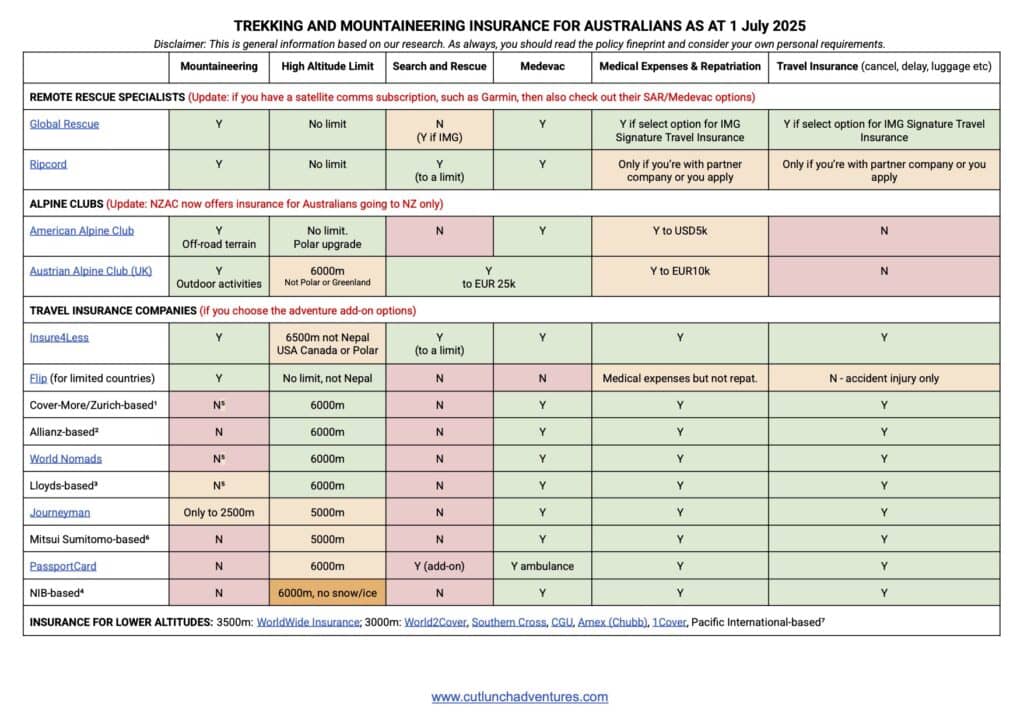
As at 2026 we’re no longer reviewing individual providers, but feel free to use our last review as at 2025 to kickstart your own research. See the image below or download it as a free pdf (no email required!). You may need a combination of providers to get all the cover you need. Links in the image are listed below.

For detailed descriptions of the types of providers, please refer to the section in our main article on Trekking and Mountaineering Insurance that cover:

  1. Check with your expedition company first
  2. Remote Rescue Specialists
  3. Alpine Clubs
  4. Travel Insurers
  5. Reciprocal Health Care Agreements and NZ ACC
  6. Insurance Aggregators/Comparison Websites
  7. Online Reviews
  8. Nepal Helicopter Rescue Scams
Summary table of trekking and mountaineering insurance for Australians
Download the PDF

NOTES

Rock & Ice climbing: some of the providers we reviewed allow for rock climbing, bouldering and ice climbing even if they don’t allow for the broader definition of mountaineering (with ropes, crampons, ice axe etc). Some have limits on altitude with rock climbing or certain types of rock climbing. We have not done a complete review of rock or ice climbing as our focus is high altitude trekking and mountaineering.

Seniors discounts worth checking out e.g. NSW Seniors discounts https://www.nsw.gov.au/community-services/seniors-card/deals-discounts/insure-and-go

Some policies require your mobile phone IMEI in the event of a claim, so make a note of it before you travel e.g. “We will not pay any claim relating to a mobile phone or device with phone capabilities if you are unable to supply the IMEI (International Mobile Equipment Identity).”

Smarttraveller travel advisory: check what you’re covered for if the advice-level changes before or during your travel e.g. last time we checked, WorldNomads specifically call this out. Others don’t and you may need to ask them e.g. in 2025 when Nepal advice changed from ‘exercise a high degree of caution’ to ‘reconsider your need to travel’ we asked our insurer who said that we’d be covered if we bought the policy before advice changed (and we had a valid reason to cancel the trip before it started), but if we chose to go then we were uncertain/unlikely to be covered. So we had to buy a new policy that covered that advice level.

LINKS INCLUDED IN THE ABOVE IMAGE

Remote Rescue Specialists

(see main article for description here)

  • Global Rescue
  • Ripcord
  • if you have a subscription for your satellite communications device, check out any add-on options for search, rescue and medevac e.g..
    • GEOS IERCC via Garmin inReach, Iridium or Inmarsat
    • FocusPoint via GlobalStar/SPOT
  • Overwatch Rescue

Alpine Clubs

(see main article for description here)

  • American Alpine Club
  • Austrian Alpine Club (UK)
  • New Zealand Alpine Club

Travel Insurers – Higher Altitudes

Note: A lot of brands have the same underlying Insurers. However note that each brand is priced differently based on the specific cover they provide – so read the fine print. We’ve also noticed that the process and service levels are not so good for policies sold by resellers or agents (rather than going direct to the main Insurer) – both for arranging evacuation and also when making claims.

  • Insure4Less
  • Flip
  • Cover-More based policies (underwritten by Zurich) are sold by Cover-More, Medibank, AHM, Webjet, NRMA (update Oct 2025: no altitude limit with NRMA?), Freely. Virgin Australia is slightly different in that they link you to Cover-More as their partner.
  • Allianz-based policies are sold by: Allianz, WorldCare, Boomers
  • World Nomads (update Feb 2026: World Nomads international brand has been sold to IMG – so not sure how this policy will change or
  • Lloyds-based policies: FastCover, Zoom
    • Zoom allows outdoor rock climbing
  • Journeyman (via Campbell Irvine)
  • Mitsui Sumitomo-based policies: Insure&Go, Tick
  • PassportCard
  • NIB-based policies (underwritten by XL Insurance Company SE) are sold by: NIB, Qantas, Travel Insurance Saver, Travel Insurance Direct and Cota
    • note that World Nomads is also an NIB-based insurer but we’ve listed this separately because unlike the other NIB-based policies they don’t exclude activities on snow/ice and they DO offer insurance for high altitude trekking (but not mountaineering). They also are the only one we’ve seen so far that specifically call out that you’re covered if the travel advisory changes after you bought the policy and booked arrangements… not to say that others exclude it though.
      • UPDATE FEB 2026: World Nomads sold to IMG – will be interesting to see how their policy changes for Australians, or whether NIB update their Australian-based policies to allow for more adventure activities including snow/ice.
    • also note that for Cota, while they say they provide insurance for senior Australians, there is no age limit for their Comprehensive or Annual plans
    • if you’re looking at any of the NIB policies (except for World Nomads) and need cover for snow/ice then check with them and get their response in writing. We experienced conflicting views from Travel Insurance Saver: one trekker was told that they would be covered for trekking on snow/ice yet when we submitted a query we were told that trekking on snow/ice would not be covered

Travel Insurers – Lower Altitudes

  • 3500m: WorldWide Insurance
  • 3000m: World2Cover, Southern Cross, CGU, Amex (Chubb), 1Cover, Pacific International-based policies (Battleface, Trippi, Travel Protect)

These are just some examples – there are many other travel insurance providers who also insure for lower altitudes.

OTHER IDEAS

Credit Card Travel Insurance

Travel insurance that comes with your credit card can sometimes cover you, at least for your basic travel needs, but they are usually more restrictive than the purchased policies e.g.

  • Excluding travel advisories of ‘reconsider your need to travel’ as well as ‘do not travel’
  • Excluding higher altitudes unless you purchase the adventure add-on
  • The amount of cover you get is often not as much as policies that you buy
  • Check what you need to do to activate the policy eg register the trip to get a policy, spend a certain amount on your trip using the credit card and have the bank statement to prove it
  • Check whether the policy is still valid if your credit card has to be replaced

Check for Discounts

It’s worth checking with your health insurer or any other memberships you have in case they provide discounts on travel insurance.

Annual Policies

If you’re doing a lot of travel then an annual policy is often cheaper than buying multiple policies.

Tips for Making a Travel Insurance Claim

Read the section in our main article for Tips on making a Travel Insurance Claim which covers:

  1. Know and follow the rules of the policy (although some can be unreasonable e.g. requiring a PCR test in a remote area)
  2. Make every effort to reduce extra costs and document how you did this in your claim
  3. Get all the supporting documentation if something goes wrong
  4. Make your claim easy to read and in the correct format

Useful links

Some other good posts on the Australian market for trekking/mountaineering insurance:

  • https://52adventuresblog.com/tag/travel-insurance-for-australian-climbers/
  • https://www.facebook.com/andrew.lock.8000metres/posts/2003963389836748
  • https://www.canstar.com.au/travel-insurance/cover-for-mountain-trekking-hiking/
  • https://www.finder.com.au/travel-insurance-trekking
  • https://www.comparetravelinsurance.com.au/travel-insurance-tips/climbing-trekking-travel-insurance

General guides on Australian travel insurance:

  • https://www.smartraveller.gov.au/choice-travel-insurance-buying-guide
  • https://www.choice.com.au/travel/money/travel-insurance/buying-guides/insurance

For travel to NZ:

  • https://www.choice.com.au/travel/money/travel-insurance/articles/travel-insurance-new-zealand
  • https://www.smartraveller.gov.au/destinations/pacific/new-zealand
Helicopter Rescue - Trekking and Mountaineering Insurance for Australians

Trekking and Mountaineering Insurance

Published February 2022 by Emma. Updated February 2026.

The most un-fun part of an expedition – trying to find the right travel insurance policy to cover trekking and/or mountaineering. Here’s a summary of what to look for and what we found.

If you’re from the UK, Europe or USA there are plenty of options. For Australians, if you so much as think about using a rope then the options dry up fast.

Our focus is on insurance for high altitude and also for the use of mountaineering equipment when needed (helmet, crampons, ice axe, ropes, harness etc).

This article includes general information about travel insurance for all trekkers and mountaineers regardless of where you live. We have a separate article which details options for Aussies. We reviewed over 45 providers encompassing insurance companies, rescue specialists, alpine clubs, climbing clubs, recommendations from expedition companies, aggregator & comparison websites, blogposts, as well as talking to other trekkers and mountaineers. As of 2026 we’re no longer reviewing each provider, but this blogpost will hopefully at least give you some pointers of what to look out for.

Disclaimer: This is general information based on our research. As always, you should read the latest policy fine print and online reviews, and consider your own personal requirements. We are not using affiliate links in the content of this article and therefore do not earn commission from any insurance companies that we mention.

In this post:
  • What to Consider when Searching for Trekking and Mountaineering Insurance
  • Trekking and Mountaineering Insurance
    • Remote Rescue Specialists
    • Alpine Clubs
    • Travel Insurers
    • Reciprocal Health Care Agreements and NZ ACC
    • Insurance Aggregators/Comparison Websites
    • Online Reviews
    • Nepal Helicopter Rescue Scams
  • Tips for Making a Travel Insurance Claim

There are new travel and adventure insurance providers popping up all the time. so it’s always worth a quick search to see what’s new. Many are just different brands who use the same underwriters. In these cases the policies are largely the same, with perhaps a few tweaks depending on the pricing or the type of travel that they specialise in.

What to Consider when Searching for Trekking and Mountaineering Insurance

  1. Decide what type of cover you need e.g. evacuation (usually from a known location), medical expenses, general travel insurance (cancellation, trip curtailment, delays, lost luggage etc), Covid, search and rescue (from an unknown location – not offered by all insurers) etc
  2. Create a shortlist of providers based on your minimum requirements e.g. highest altitude, type of activity (trekking, use of mountaineering equipment etc), destination country and travel advisory level (and if it changes – WorldNomads is the only policy we’ve found so far that specifically calls out cover for this … not to say that others exclude it though – you’ll just need to ask them). Length of trip is also important – some policies have a limit of 30 days per trip.
  3. Check other important factors e.g. pre-existing medical conditions, your eligibility (age, country of residence), risk of weather delaying internal flights, risk of natural disasters e.g. avalanches causing injury or landslides causing delays on your drive to/from trailhead, can you get a refund if your trip doesn’t proceed and you don’t need the policy any more? Note: If you’re working in a professional capacity, such as guiding, then you may not be eligible for some policies.
  4. Weigh up cost vs risk
    • Cost of the insurance policy and excess
    • Risk
      • what could happen (“events”) and how likely e.g. injury, illness, bad weather, natural disasters etc
      • what you could lose (“cover” you need) e.g.
        • cost of expedition, flights, gear
        • extra costs you could incur e.g. search, rescue, medical & repatriation, extra accommodation, flight changes
  5. Read the fine print of the policy before you purchase it. If needed, contact the insurer to get clarification (in writing) of what you’ll be covered for. Especially check for
    • General exclusions
    • Definitions of words with special meaning

Trekking and Mountaineering Insurance

There are 3 main sources of insurance for trekking and mountaineering which we’ll cover in this section – remote rescue specialists, alpine clubs and travel insurers. You may need to use a combination to get all the cover you need. We’ve also added some other aspects which are worth being aware of too.

Check with your expedition company first

If you’re going with a trekking or mountaineering expedition company then check their website or ask their advice. They often have requirements and recommendations for insurance. In some cases they may provide a referral – most often to companies like Global Rescue or Ripcord (via Redpoint) for rescue, and IMG Travel Insurance or Cover-More for travel insurance.

Remote Rescue Specialists

These companies specialise in rescue/evacuation, which is a membership service rather than insurance. You can join as a short-term or longer term member. Depending on your circumstances you may be eligible to purchase their optional add-ons of medical expenses and travel insurance. Examples:

  • Global Rescue
  • Ripcord (through Redpoint)
  • if you have a subscription for your satellite communications device, check out any add-on options for search, rescue and medevac e.g.
    • GEOS IERCC via Garmin inReach, Iridium or Inmarsat
    • FocusPoint via GlobalStar/SPOT
  • Overwatch Rescue launched a direct-to-consumer service in February 2025

What to Check or Be Aware Of

  • Rescue/evacuation service
    • Usually no limit on altitude, and allows for mountaineering
    • Polar regions are usually not covered unless you buy an upgrade
    • Some include Search whereas others will only rescue you from a known location
    • Usually require you to have 2-way sat comms e.g. Garmin inReach .. but check the rules of your destination country in case there are restrictions on these devices.
  • Insurance add-ons – while these memberships don’t include travel insurance, some offer Insurance add-ons to cover medical expenses, cancellation, luggage etc. However you aren’t necessarily eligible.
  • Hospitalisation – check what qualifies as a ‘rescue’ e.g. when we last checked, Global Rescue FAQ says that they’ll rescue you even if you don’t need hospitalisation. However their policy specifically says that they’ll evacuate for injury/illness which is life-threatening and/or requires hospitalisation. Ripcord have the hospitalisation clause too.
  • Travel advisory level (for your destination country) – it’s not very clear as to which advisory levels they include or exclude

Alpine Clubs

Some of the Alpine Clubs around the world offer a limited amount of rescue and medical expenses (not general travel insurance) for their members while participating in mountain-related activities. Other clubs are focussed more on providing access to ski lodges and mountain huts. This is what we found as at 2025:

Of those offering rescue/medical, some only allow membership from within their region e.g.

  • British Mountaineering Council
  • German Alpine Club
  • French Alpine Club

Others are open to international membership e.g.

  • Austrian Alpine Club (in German) which includes sections for
    • Belgium
    • Poland
    • Slovakia
  • Austrian Alpine Club (UK Branch) – in English
    • Search and Rescue from off-road terrain including medical and repatriation
    • Up to 6000m (with the extension >6000m only available to EU residents)
    • Excludes Polar regions and Greenland
  • American Alpine Club
    • Rescue (not search), medical and repatriation – depending on membership level. Designed for any outdoor activity.
    • No altitude limit (as far as we can see)
    • Excludes Polar regions unless you purchase the Polar Upgrade
    • They have a variety of membership options with different levels of cover.
    • Note that for more comprehensive coverage, they recommend that you buy a full membership with Ripcord, which you can get with a discount if you also buy their travel insurance. (They used to partner with Global Rescue but have switched)
  • New Zealand Alpine Club – offer insurance as follows:
    • New Zealanders travelling anywhere. Polar regions are assessed on a case by case basis. Various activities covered including trekking to 6000m and mountaineering to 7000m depending on the level of cover you choose.
    • Australians travelling to New Zealand

Travel Insurers

These companies provide general travel insurance but are usually limited in the adventure activities and altitudes they cover. You often need to buy the higher level plans or adventure optional add-ons to get the cover you need. They are:

  • Likely to include evacuation, medical expenses, cancellation, delays, lost luggage etc
  • Unlikely to include cover for mountaineering activities
  • Unlikely to include Search and Rescue 

It’s sometimes worth checking with your airline or health insurance fund in case they offer travel insurance through them for a better price.

We’ve done a detailed review of options for Trekking and Mountaineering Insurance for Australians here.

For residents of other countries you’ve probably got many more options which you’ll need to research yourself. Here are some we are aware of:

UK: TrueTraveller, Campbell Irvine, SnowCard, Dogtag, Adventures, SportsCoverDirect

USA: TripAssure, Travel Guard, Squaremouth (aggregator)

Canada: TuGo

International:

  • WorldNomads (although may not be selling in all regions yet due to Covid)
  • IMG Global (no options for Australians unless you go via Global Rescue)
  • WorldTrips (formerly HCC Atlas – excludes Australians and Canadians)
  • Global Underwriters for travel to USA (excludes Australians)
  • Journeyman (via Campbell Irvine) for international residents
  • WorldWideInsurance (for UK residents and some options for international)
  • ColumbusDirect (not selling to Australian region)
  • Clements (no options for Australians)
  • BattleFace
  • (IHI/Bupa are no longer selling travel insurance)

For more information here’s another good article about Travel, Rescue and Medical Evacuation Insurance.

Reciprocal Health Care Agreements and NZ ACC

Depending on the country you’re travelling to, you may have access to these health care services. However you’d still need travel insurance to cover all other situations. Examples as at 2025:

Reciprocal Health Care e.g.

  • New Zealand has reciprocal health care agreements with Australia and U.K. For Australians visiting NZ, ensure you take your Medicare card with you.
  • Australia has agreements with 11 different countries
  • United Kingdom also has a list of agreements

NZ Accident Compensation

  • If you’re travelling to New Zealand, there is also the unique ACC no fault scheme which provides health care if you have an accident. You may or may not have to pay part of your treatment costs.

Insurance Aggregators/Comparison Websites

They can be useful as a general overview or they can just be plain annoying if they don’t give you a full set of options because they’re biased by the commissions they’re paid.

Some have useful blogposts such as these (Aussie-based, but still some useful info for everyone)

  • https://www.comparetravelinsurance.com.au/travel-insurance-tips/climbing-trekking-travel-insurance
  • https://www.finder.com.au/travel-insurance-trekking

Online Reviews

All insurance companies seem to have good/bad reviews, and a lot come down to

  • How many questions you need to ask them before deciding to buy the policy and their quality/timeliness of response (we’ve not had issues here, but haven’t needed to ask much)
  • Claiming – depends on how diligent you are in your claim. Again we’ve had good experiences with a few companies which others have complained about.

Post Covid, many insurance companies have staff shortages or other issues which have impacted their customer service (e.g. response time for claims or queries).

Nepal Helicopter Rescue Scams

If trekking or mountaineering in Nepal, be aware of some of the tricky tactics that have been used in the past. Hopefully some of the operators have cleaned up their act since then. In 2018 the trekking world was abuzz with various scams which you can read about here:

  • https://www.nepalitimes.com/banner/heli-rescue-fraud-tarnishes-nepals-image/
  • https://www.airmedandrescue.com/latest/news/focus-helicopter-evacuations-nepal

Always check the policy fineprint wherever you’re based as things often change e.g. we read that if you’re in the UK/EU and are going trekking in Nepal, that most insurers have a policy excess of £750/€900 if you need to be rescued by helicopter for medical reasons.

Tips for Making a Travel Insurance Claim

  1. Know and follow the rules of the policy (although some can be unreasonable e.g. requiring a Covid PCR test in a remote area) e.g.
    • by knowing the correct insurance emergency number to contact for medevac. Your expedition company usually asks for your policy details so that they can assist with this
    • They may require that you have 2-way comms, such as a sat phone … but check the rules of your destination country in case there are restrictions on these devices.
  2. Make every effort to reduce extra costs and document how you did this in your claim e.g.
    • upfront
      • buy flexible flights
      • getting vaccinations
    • if an event occurs
      • try to move flights and accommodation without penalty
      • or get a refund from airline or expedition company
  3. Get all the supporting documentation if something goes wrong
    • e.g. letter from hospital, expedition company, airline etc
    • note: insurers seem to want increasingly more and more information – so ensure you get all the evidence you can to support your claim
  4. Make your claim easy to read and in the correct format e.g.
    • Submit the claim in the required format e.g. an online or pdf form as specified on the insurer’s website
    • Provide all information they ask for, in a logical order
    • Refer to the specific section/wording in the policy that you’re claiming for
    • Attach all necessary documents
    • Beware – if they have to request more information from you, or the necessary forms etc, then the clock may restart for the claim response time (the promised turnaround time of 10 days, 30 days etc to assess and respond to your claim)
Helicopter Rescue - Trekking and Mountaineering Insurance

Which mountaineering book to read next?

Published September 2020 by Emma. Updated September 2020.

Trying to decide on which mountaineering book you should read next? Or even where to start? Use our handy mind map to find a pathway for reading books you’ll like.

We created this mind map to show the connections between many of the books we’ve read. It’s by no means a complete list of mountaineering books, but it does show how many mountaineers and stories are connected, and what a small community it is.

It’s fascinating to get different perspectives on the same story or the same mountain or the same climber. The links we’ve found include:

  • mountaineers that were inspired by a particular book or person e.g. Ed Viesturs being inspired to climb by reading Annapurna
  • mountaineers that climbed together and are mentioned in each others’ books e.g. Anatoli Boukreev and Andrew Lock
  • or simply mountaineers that they came across or mentioned in their book
  • personal stories based on the same event e.g. all the books about the 1996 Everest disaster
Mountaineering books mind map

Where to start?

Popular books that people gravitate towards are those highlighted in green on the mind map i.e.

  • Annapurna – Maurice Herzog
  • Into Thin Air – Jon Krakauer
  • High Adventure or View From The Summit – Edmund Hillary

Topics to get engrossed in

14 x 8000ers – mountaineers who have completed the ‘grand slam’ of mountaineering – climbing all the highest peaks in the world over 8000m e.g.

  • Everest – Reinhold Messner – first to climb all 14 x 8000ers
  • No Shortcuts to the Top – Ed Viesturs – first American
  • Summit 8000 – Andrew Lock – first Australian and British Commonwealth citizen

Female Mountaineers – there are not nearly as many female mountaineers, so it’s fascinating to read about experiences from a female perspective e.g.

  • Arlene Blum – Breaking Trail
  • Cathy O’Dowd – Just For The Love Of It
  • Lene Gammelgaard – Climbing High

Classics – the early days of mountaineering and ascents of the 8000ers and other significant climbs e.g.

  • Annapurna – Maurice Herzog
  • Conquistadors of the Useless – Lionel Terray
  • Blank on the Map – Eric Shipton
  • The White Spider – Heinrich Harrer
  • High Adventure or View From The Summit – Edmund Hillary
  • Everest the Hard Way – Chris Bonington

1996 Everest Disaster – while we’d rather read about great mountaineering experiences rather than disasters, this topic probably has the most books written about it, and it’s interesting to read the story from so many different perspectives e.g.

  • Into Thin Air – Jon Krakauer
  • The Climb – Anatoli Boukreev with G. Weston deWalt
  • Left for Dead – Beck Weathers
  • Dr on Everest – Kenneth Kamler M.D.
  • Mountain Madness (the story of Scott Fischer) – Robert Birkby

For more books, see our list of Books to read for Armchair Mountaineers.

Happy reading!

Mt Everest

Nepal: Makalu Base Camp

Published June 2019 by Trevor. Updated May 2025.

We trekked to Makalu Advance Base Camp as part of our project to trek to the base camps of all the world’s 14 highest mountains over 8,000m. You can read our blogpost on our Project Base8000 website.

Watch the Video!

Related Posts

  • how to get to Kathmandu
  • Page 1
  • Page 2
  • Page 3
  • Go to Next Page »
  • Terms of Use
  • Privacy Policy
  • Disclosure

© 2026 · Cut Lunch Adventures